 Libre Aquatics Wiki
Daktronics HS-200 Horn Start
From Libre Aquatics Wiki, the free aquatics reference
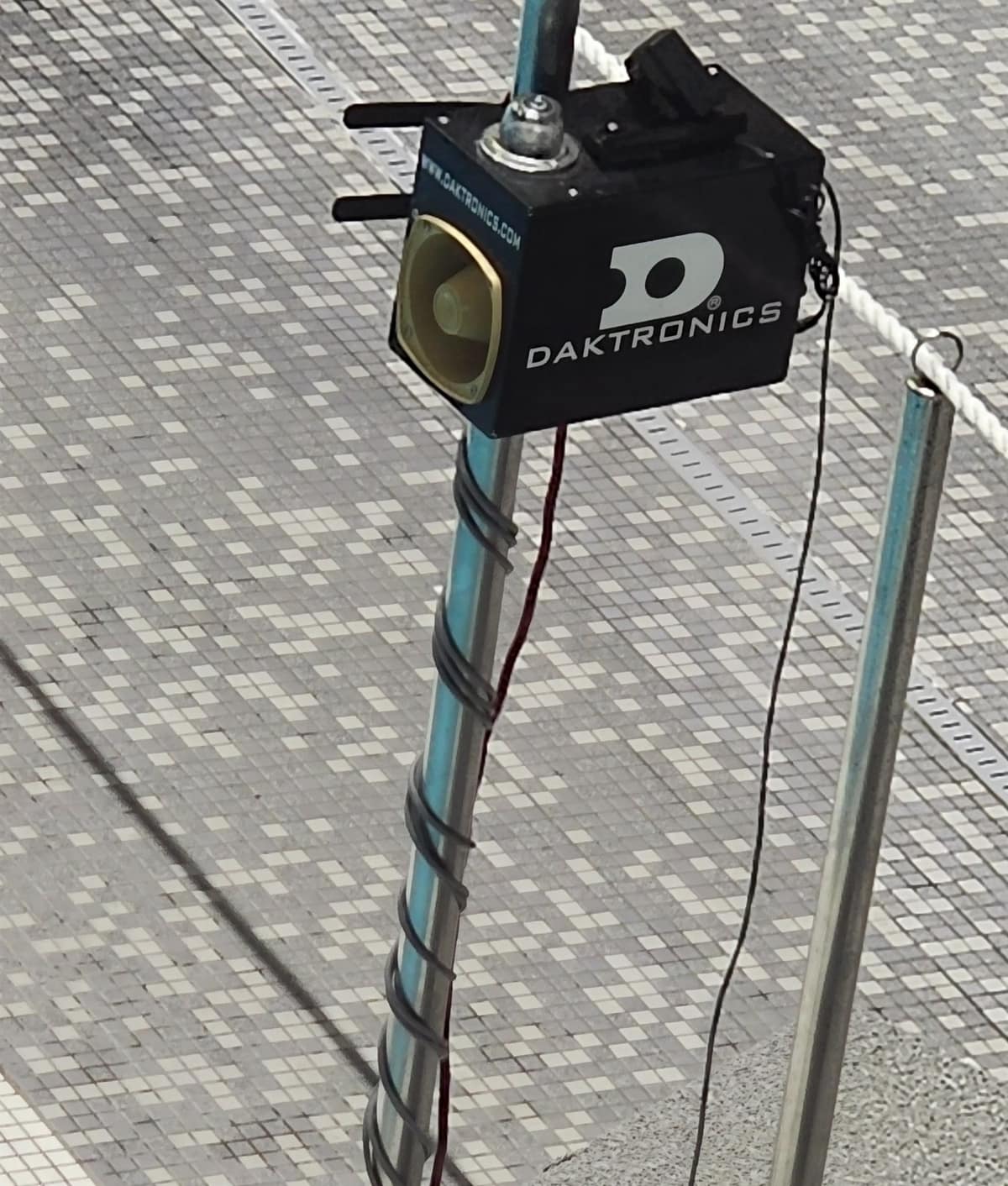
The HS-200 is a start system made by Daktronics, Inc., of Brookings, South Dakota, sold under its OmniSport timing brand as the Horn Start HS-200. It is the unit the starter uses to begin a race: pressing the start buttons on its microphone sounds a start tone through the speaker, flashes the 360° strobe on top of the case, and closes a switch contact that starts the clock on the timing console.12 The unit doubles as a public-address system for the starter’s commands, and Daktronics markets it for both aquatics and track.2 Daktronics pairs the HS-200 with its OmniSport 2000 timing console, and the unit’s start outputs also connect to other manufacturers’ timers.13
Daktronics documentation dates the system to the early 2000s: the system drawing in the owner’s manual was first issued in April 2003, and the company’s sales sheet carries a 2003 copyright.12 Daktronics lists the HS-200 both on an active start-system support page and among its discontinued product resources, so a facility may encounter it described either way.45 Replacement parts remain available from aquatics retailers.6
Role in the timing system
The start-systems overview covers the shared background that applies to every starter: the acoustic problem a start system solves, the strobe as the visual start signal, and the governing-body rules for starting equipment. The HS-200’s part is to fire its tone, strobe, and electronic start pulse together. The start pulse leaves the unit through two pairs of dual banana jacks: the jack labeled START is a normally open switch contact that closes momentarily at the start, and the jack labeled N/C is a normally closed contact that opens momentarily.1 Providing both polarities lets the unit trigger timing consoles from different manufacturers.2
With a Daktronics OmniSport 2000 console, a 30 ft (9.1 m) output cable (W-1425) runs
from the START jacks to the console’s J12 start input.1 Colorado Time Systems
consoles also connect to the START jacks, while Omega consoles connect to the N/C
jacks.1 Daktronics sells start cables for CTS, Omega, and IST timing systems,
and a 30 ft adapter cable (0A-1125-0001) for Lynx photo-finish systems used in
track.1 As with every dual banana plug in a Daktronics timing system, the plug’s
ground tab has to seat against the black socket, or the start signal never reaches the
timer.1
Design and hardware
The HS-200 is a portable unit in an aluminum case with a carrying handle, a 360° strobe dome on top, and a horn speaker in the front face.2 Daktronics describes the case as durable and lightweight; the unit measures 12 in high, 8 in wide, and 14 in deep (305 × 203 × 356 mm) and weighs 13 lb (6 kg) in the company’s specifications, though one dealer listing gives 14 lb.27 The internal speaker is rated 40 W and carries both voice and start signals.2
All connections and controls sit on the rear panel: a column of four status LEDs
(ready/recall, charging, battery full, battery low), two sealed volume knobs, the
microphone jack, speaker jacks, start output jacks, the power jack, and the main
power switch.12 The microphone jack is a CB-style four-pin
connector for the included handheld microphone (0A-1056-0173), which can be
extended up to 50 ft (15 m) with extension cables.1 The jacks are color-coded
to speed setup.2 On the wireless HS-200R model the panel adds the radio
controls: data, paired, and channel indicators and a channel-select button.1
The unit runs from an internal rechargeable battery; Daktronics rates a full charge
at 15 hours of continuous operation and states a five-year battery life span with
regular charging after each meet.12 A wallpack power supply
(A-3430138) recharges the battery from a 120 VAC outlet, and the charging circuitry
allows the unit to stay plugged in for extended periods without damage; the sales
sheet lists 120/240 VAC mains operation.12 The manual instructs
operators to run on battery power on deck and to use mains power only when the
battery is low.1
The battery LEDs show the state of charge, and when the battery-low LED begins flashing the unit has about 10 minutes of power remaining before it shuts itself down.1 Daktronics directs that the unit be charged for 24 hours after each meet and before and after off-season storage.1 The device’s ID label rates the system at 18 VDC, 36 W, and 2 A, while the manual describes the power jack as accepting a universal 12 VAC power pack; the two figures describe the unit and its wallpack differently, and the label is the figure printed on the equipment.1
Operation
The starter works the system entirely from the handheld microphone, which has two buttons: a push-to-talk lever on the side and a small start button on top. Holding the lever alone opens the microphone for commands and announcements. Holding the lever and momentarily pressing the top button sounds the start signal, flashes the strobe, and sends the start pulse.1
For 18 seconds after a start the unit is in its recall window, shown by a flashing ready/recall LED; pressing both microphone buttons simultaneously during the window sounds the false-start recall signal. The recall function can be disabled or muted where officials do not use it.1 The start sound is configurable between two swimming tones and a gunshot emulation.12 The operator changes settings without a display: plugging the microphone in, switching the unit on, and pressing the push-to-talk lever a set number of times as the LEDs flash enters a programming mode for recall, start sound, or Smart Start.1
Smart Start
Smart Start uses the start cable to detect whether a timing console is connected. With the feature enabled, the microphone still works normally, but the unit will not sound a start or fire the strobe unless a console is connected and, on consoles that report it, ready for the next race; with no ready signal available it works from cable connection alone. The feature is off by default. Daktronics says the feature eliminates the possibility of a missed start, that is, a race begun while the timer was not armed.12
Practice mode
Practice mode shortens the delay between consecutive starts from the default 18 seconds to 3 seconds so that coaches can run start training; the strobe fires at most every 10 seconds, and Smart Start is disabled while the mode is active. The manual recommends against using practice mode for timed competition. Cycling the power switch returns the unit to normal operation.1
Audio
Beyond the internal speaker, the panel provides two speaker outputs with independent
sealed volume knobs: an auxiliary output, typically feeding a single auxiliary or
backstroke speaker, and a lane output feeding up to ten individual lane speakers
(DS-1059), one behind each starting block.12 The lane speakers
are covered in the Daktronics lane speakers
article. Daktronics directs that all the external speakers be installed tilting
downward so water drains out rather than collecting inside.1
The manual’s parts list identifies the auxiliary and lane speakers as 4J (Fourjay
Industries) models but does not identify the internal speaker’s
manufacturer.1 The auxiliary speaker, 4J model 440-8, is Fourjay’s Model
440-8M marine speaker: an 8 ohm, 40 watt re-entrant compression horn built for humid
and corrosive settings, with a marine-grade polymer body, stainless fasteners, and
plated magnet parts rated to pass a 96-hour salt-spray test; Fourjay rates it for
700–6500 Hz (±3 dB) and 107 dB (1 W/1 m), at 2.6 lb (1.2 kg).8
Daktronics also sells a backstroke flagpole speaker with its mounting bracket,
0F-1056-0030, which places the speaker where the company says sound distributes
evenly across the lanes.1
Speaker extension cords are available in 10 ft (0A-1056-0081), 30 ft
(0F-1056-0047), 125 ft (0A-1056-0154), and 200 ft (0A-1056-0165)
lengths.1 Distributing the start signal through a speaker at each block is
how a start system meets the simultaneous-start requirement described in the
start-systems overview.
Specifications
| Dimensions | 12 in H, 8 in W, 14 in D (305 × 203 × 356 mm) |
| Weight | 13 lb (6 kg) per Daktronics; 14 lb in one dealer listing |
| Construction | Aluminum case, carrying handle, 360° strobe dome |
| Speaker | Internal 40 W (manufacturer not identified); outputs for one auxiliary and up to 10 lane speakers |
| Auxiliary speaker | 4J 440-8 (Fourjay 440-8M): 40 W, 8 Ω compression horn |
| Volume controls | Two sealed knobs: main/auxiliary and lane speakers |
| Microphone | Handheld dual-switch, CB-style 4-pin jack, extensions to 50 ft (15 m) |
| Start outputs | Normally open (START) and normally closed (N/C) dual banana jacks |
| Battery | Internal rechargeable, about 15 h per charge, 10 min shutdown warning |
| Mains | Wallpack power supply, 120 VAC (sales sheet: 120/240 VAC) |
| Label rating | 18 VDC, 36 W, 2 A |
| Start sound | Two swimming tones or gunshot emulation |
| Radio (HS-200R) | 2.4 GHz (earlier 900 MHz generation), 8 channels, belt-pack transmitter |
| Approvals | Certified to UL 62368-1 and CSA C22.2 #62368; ETL listed; CE; FCC |
Part numbers and accessories
Daktronics sells the system as two packages. The wired package (0A-1056-0116)
contains the HS-200 unit (0A-1056-0234), the handheld dual-switch microphone with
coiled cord (0A-1056-0173), a 15 ft (4.5 m) microphone extension (0A-1056-0122),
the wallpack power supply (A-3430138), and a 30 ft (9.1 m) OmniSport timer output
cable (W-1425). The wireless package (0A-1056-0136) substitutes the HS-200R unit
(0A-1056-0300) and adds the wireless microphone belt pack
(0A-1056-0301).1
Optional equipment includes speaker extension cords from 10 to 200 ft, a 50 ft
microphone extension, starter extension cables (W-1426, W-1517, W-1518), a
500 ft (152 m) start extension on a reel (0A-1125-0003), the remote strobe,
flagpole bracket, tripod, wireless retrofit kit, a backstroke flagpole speaker with
mounting bracket (0F-1056-0030), and individual lane speakers.1 Daktronics
services the system through its parts exchange and repair-and-return
programs.1
Backstroke flagpole bracket
A mounting bracket (0A-1056-0129) attaches the HS-200 to the backstroke flagpole,
which keeps the unit off a crowded deck and out of reach of splashing, and places
the speaker where Daktronics says sound distributes evenly across the
lanes.1 A tripod stand (A-1580), which requires the same bracket, serves
pools without a usable flagpole.1
Remote strobe
The remote strobe (0A-1056-0126) is a separate strobe unit with its own internal
12 VDC battery, also rated for up to 15 hours of use. It fires when it receives a
start signal at its universal start input, which connects to the HS-200’s START or
N/C jacks with a start extension cable; when the HS-200 is also cabled to a timer,
the strobe cable piggybacks onto the timer output cable. It needs 15 seconds between
starts to recharge its flash, turns itself off after an hour without use, and
recharges from its own wallpack in roughly three to four hours. For start training
away from the full system, a backup pushbutton can drive it directly. A dedicated
bracket mounts it to a backstroke flagpole or a starting block.1
Wireless microphone (HS-200R)
The HS-200R is the radio-equipped model of the HS-200. An internal radio module
receives from a belt-pack transmitter that the standard handheld microphone plugs
into, freeing the starter from the microphone cable; a wired microphone can still be
connected as a backup. A standard HS-200 can be retrofitted with the radio module
(0A-1056-0238).12
The radio offers eight channels (0 through 7), selected with a channel button on
each end; once both ends share a channel they pair within about 30 seconds, shown by
a paired LED on the unit. The belt pack runs about 10 hours on two AA alkaline
batteries and powers itself down when unpaired for a minute, or two minutes after
the unit is switched off.1 The manual’s parts drawing shows two radio
generations, an earlier 900 MHz version (0A-1056-0235 unit, 0A-1056-0134 belt
pack) and the later 2.4 GHz version (0A-1056-0300 unit, 0A-1056-0301 belt pack);
the manual’s regulatory table lists the 2.4 GHz belt pack.1 Facilities
running more than one HS-200R within 900 ft (275 m) of each other set the systems to
different channels, and each unit needs its own belt pack; one belt pack cannot
drive two horn starts.1
See also
- Start systems: the start-system overview and governing-body requirements
- Daktronics lane speakers: the under-block lane speakers this start system drives
- Infinity Pro Start System: the current portable Colorado Time Systems starter, the HS-200’s nearest competitor
- Championship Elite Start System: the deck-wired Colorado Time Systems starter
- T-7000 Series Touchpad: the Daktronics touchpad used with the same OmniSport 2000 console
- Timers: the timing console a start system triggers
- Equipment: the equipment reference
References
Footnotes
-
Daktronics, Horn Start HS-200 Owner’s Manual (ED-12935, Rev 17, 17 March 2021). ↩ ↩2 ↩3 ↩4 ↩5 ↩6 ↩7 ↩8 ↩9 ↩10 ↩11 ↩12 ↩13 ↩14 ↩15 ↩16 ↩17 ↩18 ↩19 ↩20 ↩21 ↩22 ↩23 ↩24 ↩25 ↩26 ↩27 ↩28 ↩29 ↩30 ↩31 ↩32 ↩33 ↩34 ↩35 ↩36 ↩37 ↩38
-
Daktronics, OmniSport HS-200 Product Specifications (SL-05774, 2017) (dealer-hosted copy of the Daktronics sales sheet). ↩ ↩2 ↩3 ↩4 ↩5 ↩6 ↩7 ↩8 ↩9 ↩10 ↩11 ↩12 ↩13 ↩14 ↩15
-
Daktronics, OmniSport 2000 timing console (the aquatics timing console the HS-200 is paired with). ↩
-
Daktronics, Start system support (describes the HS-200 as a portable starting solution for aquatics and track). ↩
-
Daktronics, Aquatics start-system discontinued-product resources (lists the HS-200 and links the ED-12935 manual). ↩
-
Poolweb, Microphone for HS-200 OmniSport start system (replacement-parts availability from aquatics retailers). ↩
-
Centaur Products, Daktronics HS-200 Horn Start (dealer listing; aluminum construction, 14 lb weight figure). ↩
-
Fourjay Industries, High Performance Marine Speakers, 200 & 400 Series (Form 357-02A) (Model 440-8M: 8 Ω, 40 W compression horn; frequency and sound-pressure specifications; marine-grade polymer construction and 96-hour salt-spray rating). ↩
Last updated September 17, 2026.