 Libre Aquatics Wiki
Colorado Time Systems Gen7 Serial Timer
From Libre Aquatics Wiki, the free aquatics reference
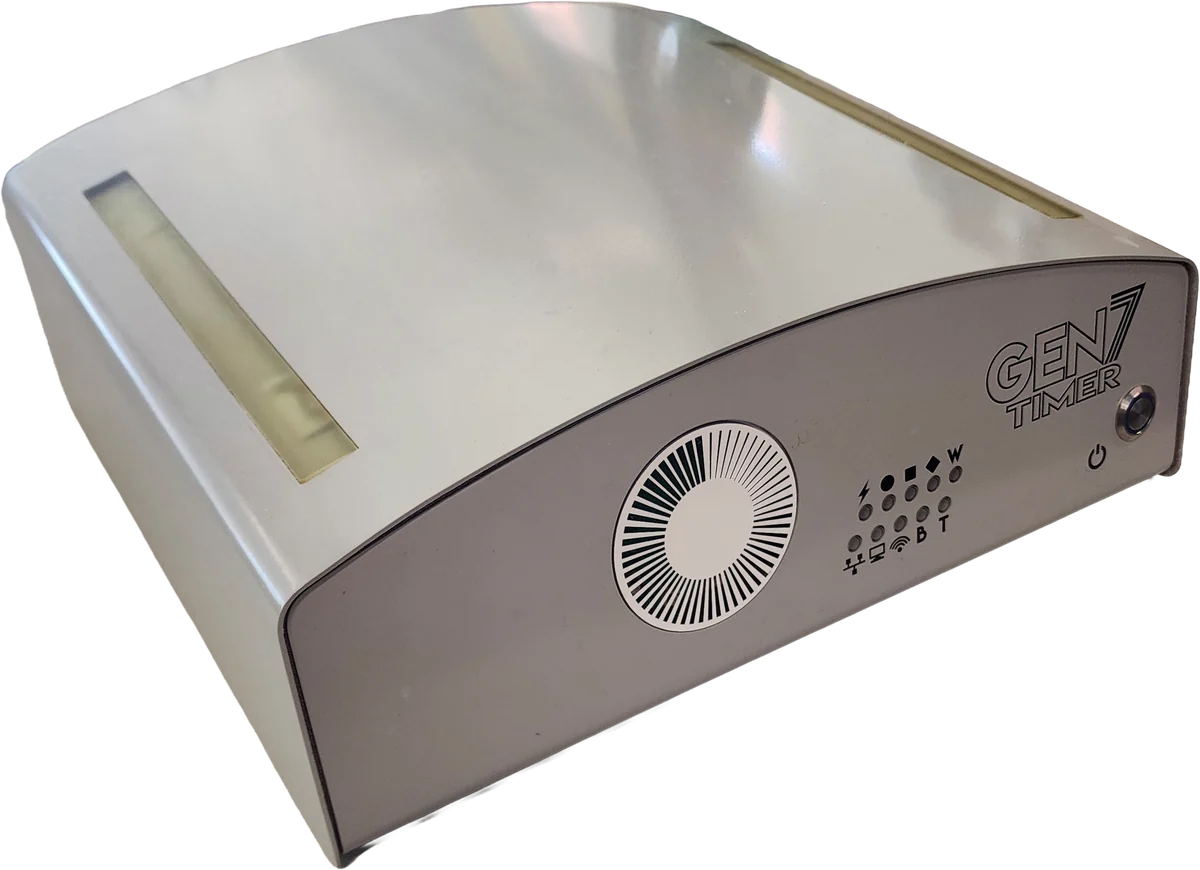
The Gen7 Serial Timer (part number GEN7-TMR) is a swimming timing console
made by Colorado Time Systems
(CTS). It is the central unit of the company’s Gen7 swim-timing platform: it
collects the finish signals from each lane’s touchpad and backup pushbuttons, runs
the race clock, and drives the scoreboard. Unlike earlier consoles, the Gen7 timer
has no built-in display or keypad; it is operated from a Windows laptop or tablet
connected over Ethernet.123
Role in the timing system
In a Gen7 installation the timer is the head end that everything on the deck connects back to. Each lane’s touchpad, pushbuttons, and relay-judging platform run through in-deck plates and cable harnesses to the timer; the starter’s console and speaker also connect to it. The timer measures the elapsed time for every lane and sends results to the scoreboard. A separate computer running CTS’s Gen7 Swimming software is the operator’s interface, and third-party meet-management software supplies start lists and receives results, but the console does the timing itself.1
Under World Aquatics rules, competition times are recorded to a hundredth of a second, and championship swimming is timed by fully automatic officiating equipment, touchpads at both ends of each lane, backed up by pushbuttons, of which this timer is the central component.4 The Gen7 platform also covers diving and water polo through other components; this article concerns the swim-timing console.2
“Serial” distinguishes this model from the
Gen7 Legacy Timer (GEN7-TMR-L). The Serial timer drives Gen7’s
newer connect-hub cabling, while the Legacy timer is built to drive a facility’s
existing older multi-pin lane hardware and scoreboards.5
Design and hardware
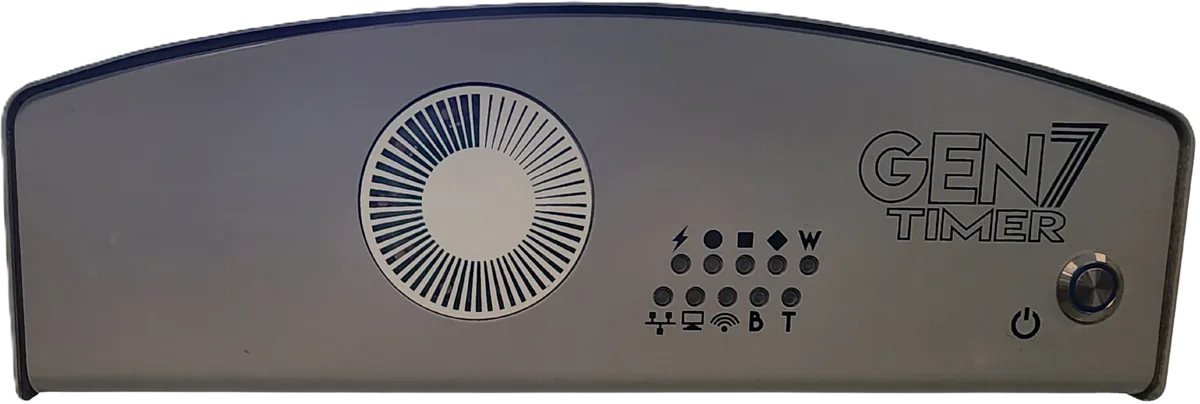
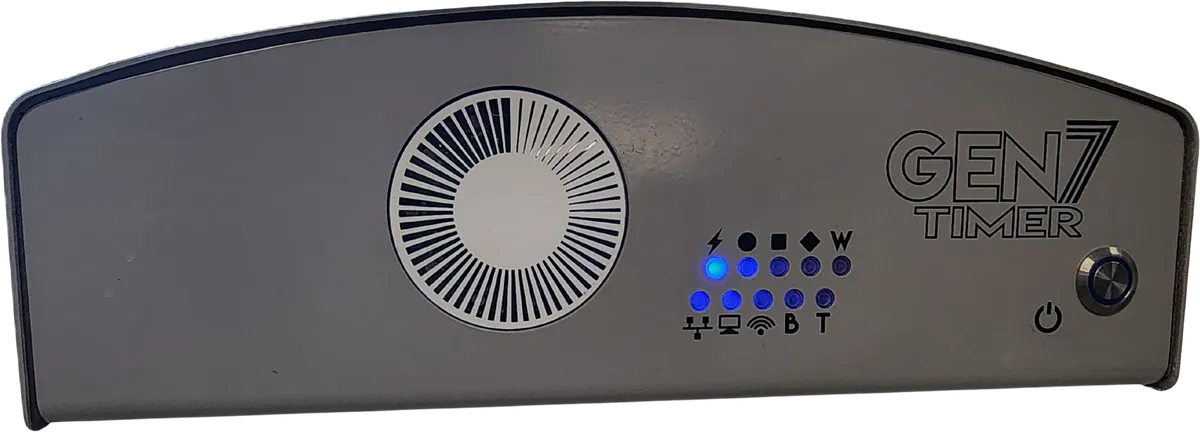
The console is a sealed unit about 4.9 in tall and 14 in wide, weighing 11 lb, with no screen or buttons other than a power button.2 A lighted bar and a row of indicators on the front convey the timer’s state:1
| LED pattern | Meaning |
|---|---|
| Blank | Not ready |
| Slow sweep | Booting |
| Pulsing | Ready for a race |
| Fast sweep | Running a race |
Additional front indicators show wired and wireless scoreboard data, network link, Wi-Fi, USB traffic, timing-event data, charging, and power. A charging light glows blue while the battery charges and is dark when charging is complete or the unit is unplugged; the charging circuit lights the indicator red if it detects a battery fault.1
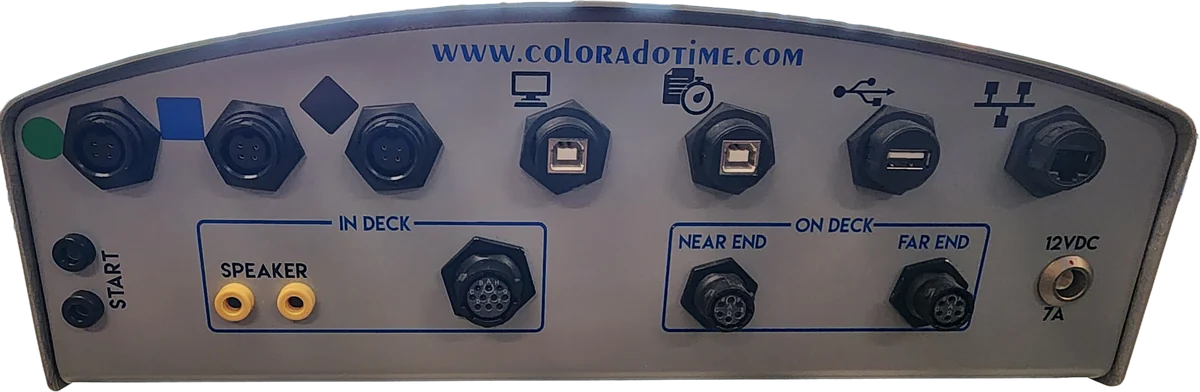
The timer runs from a 12 VDC supply or an internal 7.2 V, 10,000 mAh nickel-metal-hydride battery. CTS rates that battery for up to about six hours of normal use on a small (roughly ten-node) in-deck system or cable harnesses, dropping to about three hours on a large (roughly sixty-node) system.1 The rear panel carries connectors for scoreboard data, a CTS expansion port, meet-management, USB, Ethernet, the start system and its speaker, an in-deck connection, separate on-deck near-end and far-end connections, and power.1
Connectivity
The Serial timer uses CTS’s connect-hub cabling. Connect hubs for the timer, start system, scoreboard, and bulkhead are uniquely keyed and colour-coded so each component can only be plugged into the right place, and they use corrosion-resistant titanium connectors that are wet-pluggable: they purge water while making the connection, so bulkhead connections no longer have to be kept dry.2 CTS holds a patent on this networked-node approach, in which the connection points have “spatial awareness” that simplifies configuring the system.6
Lane signals reach the timer through titanium deckplates (CTS cites a separate patent for their domed, corrosion-limiting design and integrated starter-light connection), wired back through near-end and far-end serial harnesses that can be chained far enough to carry both a primary and a backup harness across 20 lanes.21 Connect hubs and plates can be mounted in the deck or in wallplates, and CTS notes that outdoor floorplates can replace older deck “tombstones.”2
The start system connects either directly to the timer (separate cables for the start signal and the speaker) or through a start node in the wall or deck; the timer has an integrated start and speaker input.1 Scoreboard outputs drive LED numeric and LED video displays.2 How meet-management software connects to the timer is covered under Meet-management software below.
Software and operation
The operator’s laptop or tablet runs Gen7 Swimming software and reaches the timer over the same network, by cabled Ethernet, Wi-Fi, or a direct cable. On start-up the software discovers the timer automatically (or by a manually entered IP address); when several timers share a network, each timer’s coloured “case lights” help tell them apart. The operator then creates or opens a meet and session, choosing a governing body and the course configuration.1
The timer and its computer must share one network. The Gen7 software finds the timer by Zeroconf auto-discovery (UDP port 5353) and controls it over an encrypted, authenticated channel (TCP port 7105), with a separate SSH channel (TCP 22) used for diagnostics; a timer with a static IP address can instead be entered manually, and if no DHCP server is present the timer self-assigns an address in the 169.254.x.x range so a laptop can be cabled straight to it. The SSH login permits no remote root access, and each timer’s login password is assigned randomly at the factory and shared with no other unit.1
During a session the main screen shows the timer’s state, Ready for Start, the running time, and Finished, with a toolbar for printing, race data, diagnostics, and settings. Because the layout is defined in software, a facility can change the course configuration without moving cables, switch off unused inputs and lanes to save power, and run up to four courses at once from one timer using separate computers.21 The software also adds several meet-running options: an “Event 0” test-race mode that runs a full test without affecting meet data, running only even or odd heats or only one gender’s events, and a per-lane distance setting that lets one or more lanes finish in fewer lengths than the rest of the race, which CTS describes as intended for merging time-trial events.5
Two features address reliability. A pre-meet diagnostic screen checks the health of the whole system and can flag connections that are corroding or wired incorrectly; CTS holds a patent on detecting and identifying timing components by their electrical signature.72 And a race-finish safeguard logs all timing data on the timer itself: if the laptop or tablet interface drops, the timer keeps running and will finish the race, with the raw data available for replay. A second timer can still be added for redundancy, but is not required as it was with a System 6 console.215
Meet-management software
Third-party meet-management programs supply start lists to the timer and record the results it returns. The console does the timing itself. The meet-management computer can connect to the Gen7 in four ways:
- By USB directly to a port on the timer, where the computer sees it as a virtual serial (COM) port.
- By USB to the Gen7 interface laptop, through CTS’s USB-Connect coupler (part
USB2USB), which simulates a null-modem serial link over USB. - Over the network by file sharing, in which the meet-management computer and the Gen7 laptop read and write a shared Windows folder, enabled as the meet-management file-export option in the software settings.
- Over the network by a UDP link, which carries the swimmers’ names from the meet-management software to the Gen7 for the scoreboard, along with team scores and full event results, and is described below.
The first three connections carry the event sequence into the timer and the race results back out, and they exchange the same data, so the choice among them is practical. The two USB options depend on whether the meet-management computer is within cable reach of the timer or of the laptop; file sharing serves a computer that is on the network but beyond USB reach of both. Over any of the three the meet-management software downloads the event sequence to the timer, so the console matches the meet program, and reads back each race’s results.1 With Hy-Tek Meet Manager the timer appears as a USB serial port; Meet Manager is then set to its Colorado Time Systems interface to open it.8 SwimTopia’s Meet Maestro detects the timer automatically and imports each race’s touchpad, pushbutton, reaction, and split times. SwimTopia lists its Gen7 support as a beta feature.9
The fourth connection, the UDP link, feeds display data the other way, to the Gen7 for the operator’s screen and the scoreboard. Since Gen7 Swimming v2023 the console can take swimmers’ names from the meet-management program and show them on screen and on an LED video board. This removes the need for a direct link between the meet-management computer and the computer running DisplayLink Plus (DL+), and requires DL+ v4.6.0 or later. The names can be pre-loaded from SCB files on a USB drive or sent live over the UDP connection. The live feed also carries team scores and complete event results, added in Gen7 Swimming v2026 with DL+ v4.7.0. The UDP link runs between the meet-management computer and whichever of the Gen7 timer or the Gen7 computer shares its subnet; it cannot cross subnets. Once the operator sends an initial start list, the link becomes bidirectional, and the Gen7 requests a fresh start list whenever the event or heat changes. Of the meet-management programs, CTS notes that only Hy-Tek Meet Manager supports this UDP data, over UDP Ethernet on port 60287, and that it needs Hy-Tek’s Alpha Scoreboard licence. Name integration also requires an RS-485 link to the DL+ computer rather than RS-232.1
Compared with earlier consoles
Both Gen7 timers replace CTS’s earlier System 5 and System 6 consoles. CTS first announced the Gen7 platform, beginning with the Serial in-deck system, in April 2017, and gave it a wider launch that December.1011 Where System 6 was a self-contained console operated from its own keypad and ran one course at a time, the Gen7 timers move the interface to a Windows computer and let one timer run multiple and simultaneous courses, recover from an interface failure without a second backup timer, connect to meet-management software over USB or Ethernet, and accept an integrated start and speaker input.2 Within the Gen7 line, the Serial timer suits new installations built around connect-hub cabling, while the Gen7 Legacy Timer reuses existing multi-pin lane hardware.5 Both Gen7 consoles remain current products, sold by CTS and stocked by independent aquatic-equipment dealers.12
Specifications
| Dimensions (H × W × L) | 4.90 × 14.23 × 13.07 in (12.45 × 36.14 × 33.20 cm) |
| Weight | 11.0 lb (5.0 kg) |
| Operating temperature | 0–45 °C (storage −20–70 °C) |
| Humidity / altitude | 90% non-condensing; 0–3000 m |
| Power | 12 VDC, 7.5 A Class 2 supply |
| Battery | 7.2 V, 10,000 mAh NiMH; ~6 h (small system) to ~3 h (large system) |
| Scoreboard outputs | RS-485 (3 V, 300 mA) |
| Data | Gigabit Ethernet (isolated); USB; start input 3.3 V |
| Certifications | cULus, FCC, RoHS |
| Patents | US 10,137,353; US 11,192,016 (system); US 8,602,815 (deckplate) |
Installation and safety
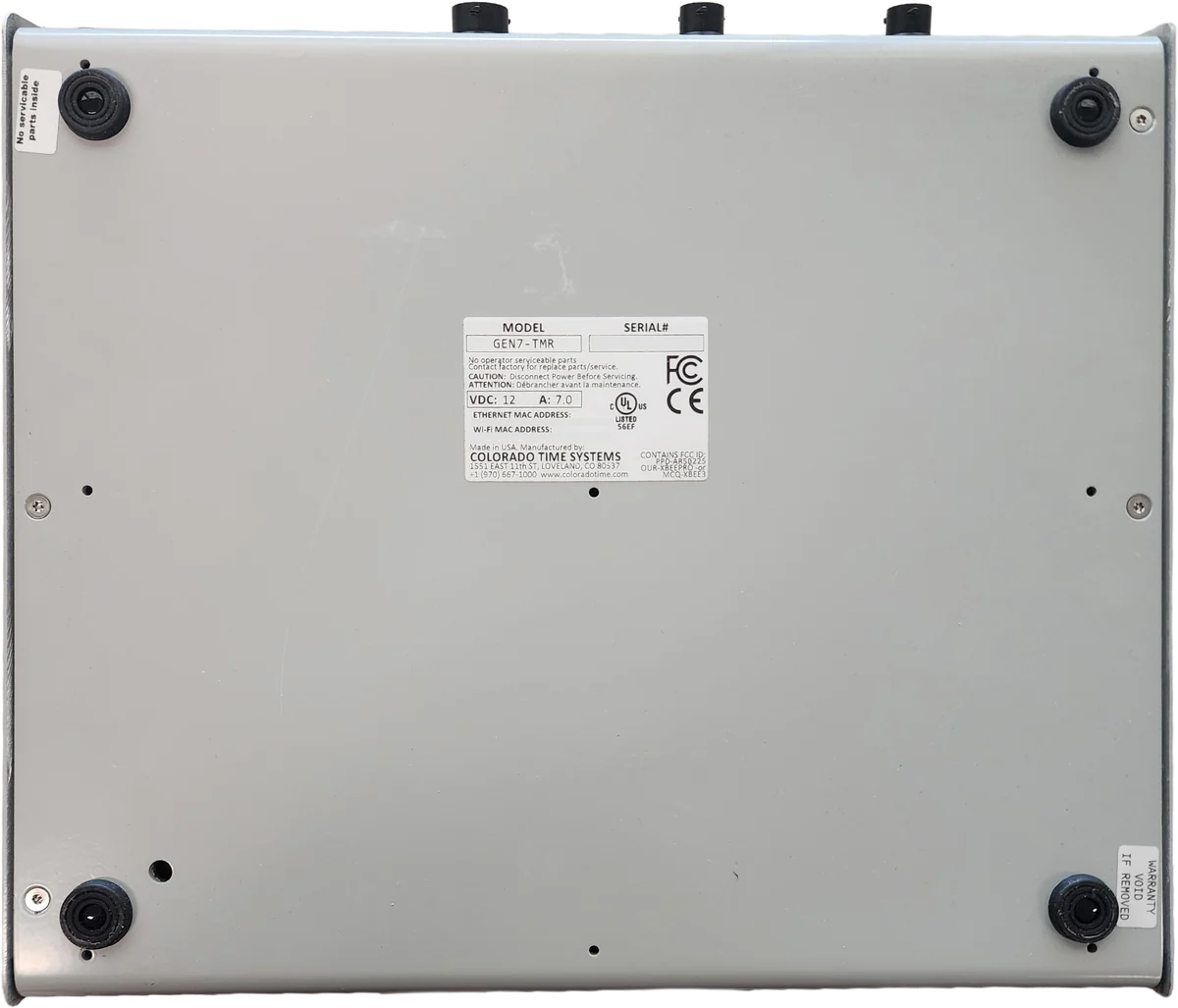
The Gen7 timer is made for indoor or outdoor pools and must be installed to the electrical code for its location (in the United States, the National Electrical Code), and kept far enough from the water that it is not splashed.1 A unit brought in from the cold should be allowed to reach room temperature before use to avoid internal condensation. There are no user-serviceable parts inside; opening the enclosure voids the warranty.1
Part numbers and accessories
GEN7-TMR, Gen7 Timer.R-920-05x, power supply (regional plug variants).R-600-302, laptop for the user interface.R-470-117, Gen7 Swimming software (R-470-118, software maintenance).USB2USB, CTS USB-Connect coupler, linking a meet-management computer to the interface laptop over a simulated serial connection.- Connect hubs (timer, starter, scoreboard, bulkhead), titanium deckplates, wallplates, and connection cables and harnesses (up to 20 lanes).
TP-GEN7-6/TP-GEN7-8/TP-GEN7-10, 6-, 8-, and 10-lane touchpad systems (harness, pushbuttons, meter, and vacuum pump; touchpads sold separately).
See also
- Timers: the timing-console overview and the Gen7 comparison table
- Gen7 Legacy Timer: the multi-pin console in the same platform
- Colorado Time Systems: the manufacturer
- Equipment: the equipment reference
References
Footnotes
-
Colorado Time Systems, Gen7 Serial Timer User Guide (F1034). ↩ ↩2 ↩3 ↩4 ↩5 ↩6 ↩7 ↩8 ↩9 ↩10 ↩11 ↩12 ↩13 ↩14 ↩15 ↩16
-
Colorado Time Systems, Gen7 Serial Swimming datasheet, archived; CTS has withdrawn the original. ↩ ↩2 ↩3 ↩4 ↩5 ↩6 ↩7 ↩8 ↩9 ↩10 ↩11
-
World Aquatics, Swimming Rules, competition times are recorded to a hundredth of a second, timed by automatic officiating equipment. ↩
-
Colorado Time Systems, Serial or Legacy, Which Gen7 Timer is Right for You?. ↩ ↩2 ↩3 ↩4
-
US Patent 10,137,353 B2, System for timing and scoring aquatic sports in pools (assignee Everlast Climbing Industries, dba Colorado Time Systems; inventor Chris Stockinger et al.). ↩
-
US Patent 11,192,016 B2, Apparatus and method for the detection of timing components in swimming pools (assignee Everlast Climbing Industries, dba Colorado Time Systems). ↩
-
Aquatics International, Colorado Time System Introduces Gen7 Swim Timing and Scoring (April 2017; Serial in-deck system, up to 20 lanes). ↩
-
Aquatics International, Colorado Time Systems Launches Gen7 (December 2017). ↩
-
Dealer listings: Recreonics, CTS Gen7 Legacy Swim Timing; Team Aquatic Supplies, CTS Gen7 Legacy Timing. ↩
Last updated September 17, 2026.